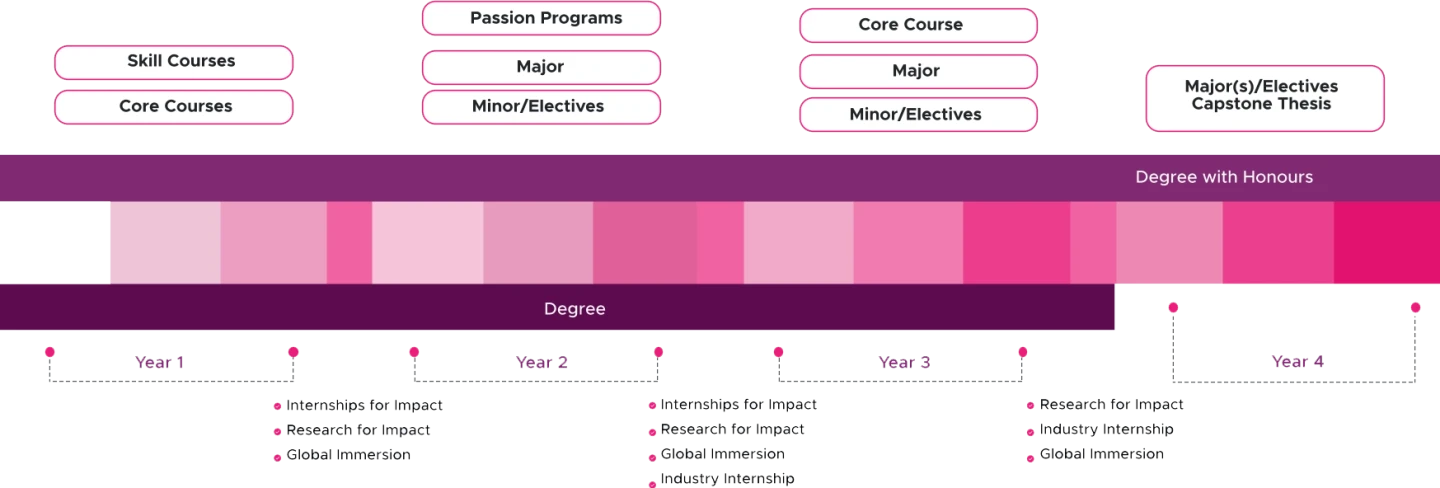
Multidisciplinary Minor (MN)/Open Elective (OE) are generally Courses that a student chooses from courses being offered by other departments / Schools. A course declared as a Multidisciplinary Minor/Open Elective for one Program may be declared as Program Core/Elective for any other Program. This gives an opportunity for students to satisfy their aspirations in other disciplines also. Since Multidisciplinary Minor(MN)/Open Elective(OE) courses offered by a particular Program are expected to be taken by other disciplines, they may not have a prerequisite other than those that appear under Multidisciplinary Course. The total number of open electives to be taken shall vary as per the scheme of the program the student is pursuing.
UG students shall have the option to pursue a minor. If a student chooses all his open electives from a particular basket as per the scheme of his program, plus he completes additional credits as open electives from the same basket, as prescribed in the respective Minor regulations, he would be deemed to have earned a Minor. He is also required to fulfill the eligibility conditions of the Prerequisites for doing a Minor. On successful completion of the credit requirements, a certificate for the MINOR shall be awarded to the student.
Minor Options Available
Students at Quantum University are encouraged to choose related and/or unrelated courses in other disciplines through minor programs.
Entrepreneurship & Startups
Foreign languages (French)
Media Management
Financial Literacy
Robotics & Automation
Microsoft Office
Culinary Arts
Data Analytics
Web Designing
A few combinations of Major-Minor can be
Major in Computer Science with a Minor in Economics
Economics imbues the engineer with a socio-economic sense aimed at developing an understanding of the market forces. This is integral to realizing cost-effective business models. Only through successful business models can new technologies develop. The economic perspective provides the essential know-how of capital markets, risk management, asset evaluation, economic policy, business law, and managerial practice. Economics thus acts as an incubator for entrepreneurial ideas in the technical domain. Finally, this leads to a fruitful interface between academia and industry.
Major in Hotel Management with a Minor in Entrepreneurship
Hotel management is a challenging field that needs harmonizing activity in front office operations, food and beverage production and distribution, and accounting. Modern trends in the hospitality industry have added a focus on sales, marketing, maintenance, and security. Training in Entrepreneurship develops creative business thinking. This enhances risk-taking ability via dedicated risk management. This combination of subjects helps individuals diversify their hotel business to manage capital with a risk purview, actively profile loans and funds, optimize business cycles, and maximize profit scenarios.
Major in Physics with a Minor in Mathematics
This combination would suit prospective students in research in physics or Mathematics. Physics fascinates with its intellectual challenge and numerous applications in engineering and technology. It explores nature via theoretical models. Experimental physics tests theories. It's a vibrant field. Students can explore relativity, quantum mechanics, statistical mechanics, Lagrange-Hamilton formulation, action principles, and quantum field theories. Mathematics helps make the qualitative physical models quantitative and amenable to experimental exploration. Therefore, a minor in mathematics would prove most beneficial to a physics course.


 Undergraduate
 Postgraduate