


 Undergraduate
 Postgraduate
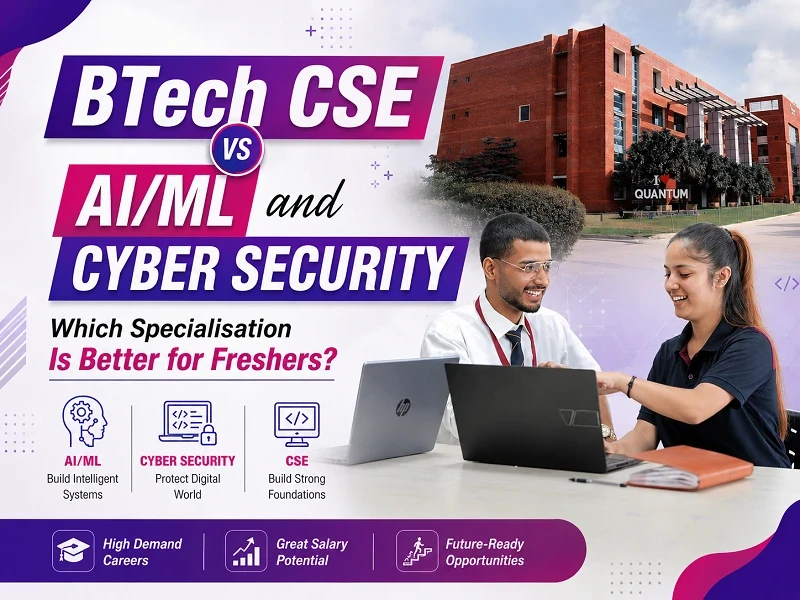
A CSE degree gives you a broad introduction to computing, while specialised programmes take you deeper into areas such as AI/ML or cyber security. Neither choice is automatically better. A specialised course can give you earlier exposure to a particular field, but you will still need strong programming and problem-solving skills. Core CSE, on the other hand, leaves you with more room to explore before choosing a direction. Think about what you actually enjoy studying. Do you like mathematics and data, or are networks, systems, and security more interesting to you? That answer can tell you more than a popular course title.
The Core Debate: Definitions and Academic Realities
Making an informed decision requires looking past marketing buzzwords to understand exactly what each academic track demands over four years of intense study.
1. BTech Computer Science & Engineering (Core)
The Core CSE program provides a good general knowledge base of computer science and does not immediately take you into any particular specialization. The courses you take will include programming, data structures and algorithms, operating systems, computer networks, databases, and other basic aspects of computer science. This kind of training may be beneficial for you if you have not decided yet what aspect of technology to focus on.
- Core Components: Object-oriented programming, data structures and algorithms, operating systems, computer networks, and databases.
2. BTech (Hons.) CSE with Specialization in AI & ML
The programme builds computer science foundations alongside specialised study in areas such as AI, machine learning, deep learning, data modelling, and related technologies. You spend significant time writing code that processes data patterns to make automated, predictive decisions.
- Core Components: Linear Algebra, Probability, Deep Learning Frameworks, Neural Network Architecture, and Big Data Processing.
Read Our Blog:B.Tech Colleges in Uttarakhand: Costs, Curriculum, and Institutional Selection Guide
3. BTech (Hons.) CSE Cyber Security and Digital Forensics
Cyber Security and Digital Forensics takes a more focused approach to computer science, with greater attention to protecting systems, identifying vulnerabilities, and investigating security incidents. Students work with areas such as network security, defensive system configuration, and post-attack analysis. The programme therefore places more emphasis on securing and analysing digital systems than on general software development.
- Core Components: Cryptography, network security protocols, penetration testing, ethical hacking, and information security compliance.
BTech Core vs Specialization Placement: The Regional Reality
Evaluation processes that are carried out by technology service firms and corporate recruitment teams during visits to the engineering centers operate within certain guidelines. There are quite a number of entry-level technology recruiters who still assess the applicant based on his or her programming skills and computer science basics. Specialisation does not remove the need for strong fundamentals. Recruitment criteria vary by employer, but programming, problem-solving, and core CS knowledge remain relevant for many entry-level technology roles. If a candidate cannot clear basic logic evaluations or handle standard database queries during initial screening rounds, advanced domain knowledge rarely alters the outcome. Versatility can matter for employers hiring fresh graduates into general software and technology roles, where employees may later work with different client requirements or technology stacks.
Is AI ML Specialization Worth It for Freshers?
To decide if a specialised track provides genuine value, you must weigh its distinct career benefits against the real functional challenges you will face in the entry-level job market.
The Benefits
- Direct Applied Experience: You work with data science pipelines and neural models early in your education.
- Advanced Research Readiness: The mathematical focus provides a strong springboard if you intend to pursue postgraduate research.
- Targeted Industrial Exposure: Integrated programmes may provide industry-linked training, workshops, projects, or other forms of domain-specific exposure.
The Challenges & Pitfalls
- Lack of Entry-Level Positions: Certain jobs in data science and machine learning will demand higher education or work experience from candidates; therefore, new graduates might find themselves taking jobs in software engineering or other related fields before landing the job of their choice.
- Mathematically Intensive Studies: It is necessary to be quite comfortable with the abstract mathematical principles of statistics, multi-variable calculus, and mathematical optimization.
- Over-Specialization: If you specialize yourself at an early stage of your studies, then you will lack the ability to write normal programs by using any of the standard construction frameworks.
What About Cyber Security?
Cyber Security follows a different path from AI/ML. Students interested in networks, security architecture, ethical hacking, digital forensics, and threat analysis may find this specialisation more aligned with their interests. It can still require strong programming and computer science fundamentals, particularly because security work often involves understanding how systems and networks operate.
BTech CSE vs AI/ML vs Cyber Security: Which Path Fits You?
So, when comparing BTech CSE vs AI/ML which is better? And where does Cyber Security fit into the decision? The answer depends on your career goals, academic interests, and willingness to specialise early.
| Evaluation Parameter | Core BTech CSE | BTech (Hons.) CSE Specialisations |
| Curriculum Versatility | High. Covers full stack, cloud, systems, and databases. | Medium. Replaces general electives with domain modules. |
| Initial Placement Scope | Broad. Open to web, mobile, system, or cloud roles. | Targeted. Focuses primarily on analytics, data, or security. |
| Specialisation Cost | Standard university technical tuition framework. | Specialised programmes may have different fee structures from core B.Tech programmes, depending on the university and programme. |
| Career Pivot Flexibility | Allows you to learn AI or Security later via certifications. | Requires independent study to pivot back into general systems. |
| Industry Collaboration | General university industrial partnerships. | Industry collaboration varies by programme. |
BTech CSE and Specialisations at Quantum University
Once you understand the difference between core CSE and specialised tracks, the next question is where you can study them. Quantum University in Roorkee offers BTech CSE alongside several BTech (Hons.) specialisations, including AI & ML, Cyber Security and Digital Forensics, and Full Stack Development. The university offers core CSE alongside specialised programmes, with industry collaborations attached to several of its specialised tracks.
1. Corporate Collaborations and Lab Infrastructure
Quantum University builds its honors tracks in partnership with professional training and analytics organizations to introduce real-world development environments early.
- AI & ML Track: Offered in collaboration with Samatrix, with training focused on AI and ML applications.
- Cyber Security Track: Offered in collaboration with Quick Heal, with training covering areas such as ethical hacking, network security, and digital forensics.
- Full Stack Development Track: Co-curated with iNurture to emphasize modern web application deployment.
- Open Source Lab: The campus features an active Open Source Lab where students get hands-on experience with Linux environments, shell scripting, and version control.
2. The Interdisciplinary Minor System and CODEX
The university allows engineering students to step out of their primary department. Through its interdisciplinary minor system, students can explore areas outside their core degree, with options listed by the university including Financial Literacy, Media Management, Data Analytics, Entrepreneurship and Startups, and Robotics & Automation. The CODEX Club gives students another setting to apply these skills. It organises coding competitions, hackathons, and CodeFest events where students can build and demonstrate technical projects. This helps bridge the gap between classroom theory and competitive execution. Read Our Blog: Top 20 Best Colleges in Uttarakhand
Common Mistakes Students Make During Admission
- Choosing a specialisation just for the name: The name of a course can be deceiving. Read the syllabus to find out what you will actually learn in that course. A course that carries the names like AI or something data-related does not mean that it is completely free of CSE.
- Neglecting fundamentals: Specialisations are good and relevant but they cannot substitute the basics. Data structure, algorithm, databases, and basic programming skills remain very relevant even if you want to specialise in something in the future like AI or other things.
- Believing in placements without verification: Numbers quoted by one college as an average and another college as a median number do not have to be comparable. Find out where those numbers come from, in which batch they belong to and how colleges calculate them.
Core CSE vs AI/ML vs Cyber Security: Which Career is for You?
The better comparison to make here is in terms of where things go from there after obtaining the degree. Core CSE helps you build an even wider platform on which you can shift into various technical fields. AI/ML and Cyber Security lead you to certain technical domains, though ultimately your future job depends on other factors too.
What Do Job Opportunities and Salaries Look Like?
The Indian Job Market
Core CSE can still open up plenty of career options in India. Software developers are needed across different industries, and graduates can work with a range of technologies rather than being limited to one sector. However, specialised areas are becoming more attractive as well. AI, cloud computing and cybersecurity are seeing growing interest from employers, although the skills expected for these roles can be quite different.
| Area | Typical Indian salary position | What to keep in mind |
| Core CSE / Software | Entry-level salaries differ based on the company, location and type of role. | The field offers a wide choice of jobs, including software development, testing and other technology roles. |
| AI/ML and Data | Salaries can increase as professionals gain experience and move into more specialised positions. | Along with programming, students need a good grasp of statistics and practical AI or data skills. |
| Cyber Security | Pay varies between entry-level security jobs and more specialised positions. | Networking knowledge, hands-on labs, certifications and work experience can help when moving into higher-level roles. |
However, there is another difference to note between specialization and being employable within that specialization. A BTech Degree holder might take up AI/ML courses, but they can start their careers in a software or data science job. Likewise, a Cyber Security degree holder might have to gain some practical experience in the field before proceeding with his/her specialized job. The current recruitment trends in India highlight that practical experience matters the most.
What About Opportunities Abroad?
The picture changes somewhat when you look at international markets. The U.S. Bureau of Labor Statistics, for example, reports a May 2024 median annual wage of $133,080 for software developers, $112,590 for data scientists and $124,910 for information security analysts. Its 2024–34 projections also show particularly strong growth for data science and information security.
| Career area | U.S. median annual wage, May 2024 | Projected growth, 2024–34 |
| Software Developers | $133,080 | 15.8% |
| Data Scientists | $112,590 | 33.5% |
| Information Security Analysts | $124,910 | 28.5% |
These are U.S. occupational figures, not fresher salaries. They include professionals at different stages of their careers, so an Indian graduate should not interpret them as an expected package immediately after graduation. The relevant lesson for the Indian student aspiring to work internationally is the range of career opportunities available. Computer programming knowledge continues to be applicable regardless of the country, whereas AI, data science, and cybersecurity careers are providing new avenues for specialization. Working in a different country, however, could entail meeting certain qualification criteria, authorization, and even further education or experience.
Which Path Has Wider Career Scope?
Core CSE offers the broadest starting point. Its subjects can lead towards software development, cloud computing, systems, databases and other technology areas. You can also build additional skills later and move into AI, data or security. There are uses for AI/ML in different industries including tech, finance, medicine, production, and research. But jobs requiring specialisation might require more advanced skills. Cyber Security has practical application in all places where it is necessary to secure computer networks, systems, and information. It is used in finance, medicine, government, tech companies, and many others. International labor markets operate on the same principle, but employment requirements vary in each country and organizations. Programming skills can be valuable in all markets, while specialist roles may ask for additional qualifications, certifications, portfolios or professional experience.
Conclusion
So, BTech CSE vs AI/ML, which is better? It depends on the kind of technical background that you seek during your degree. The Core CSE programme gives you exposure to programming, databases, operating systems and software engineering. The AI/ML programme takes you further into domains like machine learning, data analytics, and mathematical modeling. If you have realized that these topics suit you, then opting for a specialized program could be worthwhile. Otherwise, a Core CSE program gives you scope to explore different dimensions of computer science. Also, the university plays an important role here. At Quantum University, you can choose from core CSE and specialized programs with the inclusion of industry-linked learning, practical courses, inter-disciplinary learning, and more, along with the curriculum. Before choosing between the two, compare the actual subjects, hands-on experience, fees and other aspects of both the programs. Titles of degrees give you an idea about where a program would lead you to. Curriculum shows what subjects you need to learn.
Frequently Asked Questions (FAQs)
Can a core BTech CSE student apply for specialised AI or Cyber Security job profiles?
Yes. Corporate recruiters evaluate your actual skill competency over your exact degree title. A core computer science student who builds strong machine learning portfolios and completes verified domain certifications can apply for specialised roles during campus drives.
Is the tuition fee higher for specialised engineering tracks?
Specialised programmes may have different fee structures from core B.Tech programmes, depending on the university and programme. Students should check the current official fee structure before comparing total costs. Always check the official university fee sheet for current batch rates.
Do mass recruiters prefer core engineering graduates over specialised honors students?
Mass recruiters generally prioritize versatile freshers who can pass basic aptitude rounds and write clean code in Java, Python, or C++. They look for adaptable candidates who can be trained and deployed across a wide variety of client projects.
What is the median package for engineering graduates at Quantum University?
According to Quantum University's NIRF 2026 engineering submission, the median salary of placed UG graduates was ₹4.50 lakh in the 2024-25 reporting year, compared with ₹4.70 lakh in 2023-24 and ₹4.60 lakh in 2022-23. Quantum separately reports an average placement package of ₹5.8 LPA on its website, so median and average figures should not be treated as interchangeable.
What is the highest package reported by Quantum University?
Quantum University reports a highest placement package of ₹33.5 LPA on its official website and promotional placement assets.
