


 Undergraduate
 Postgraduate

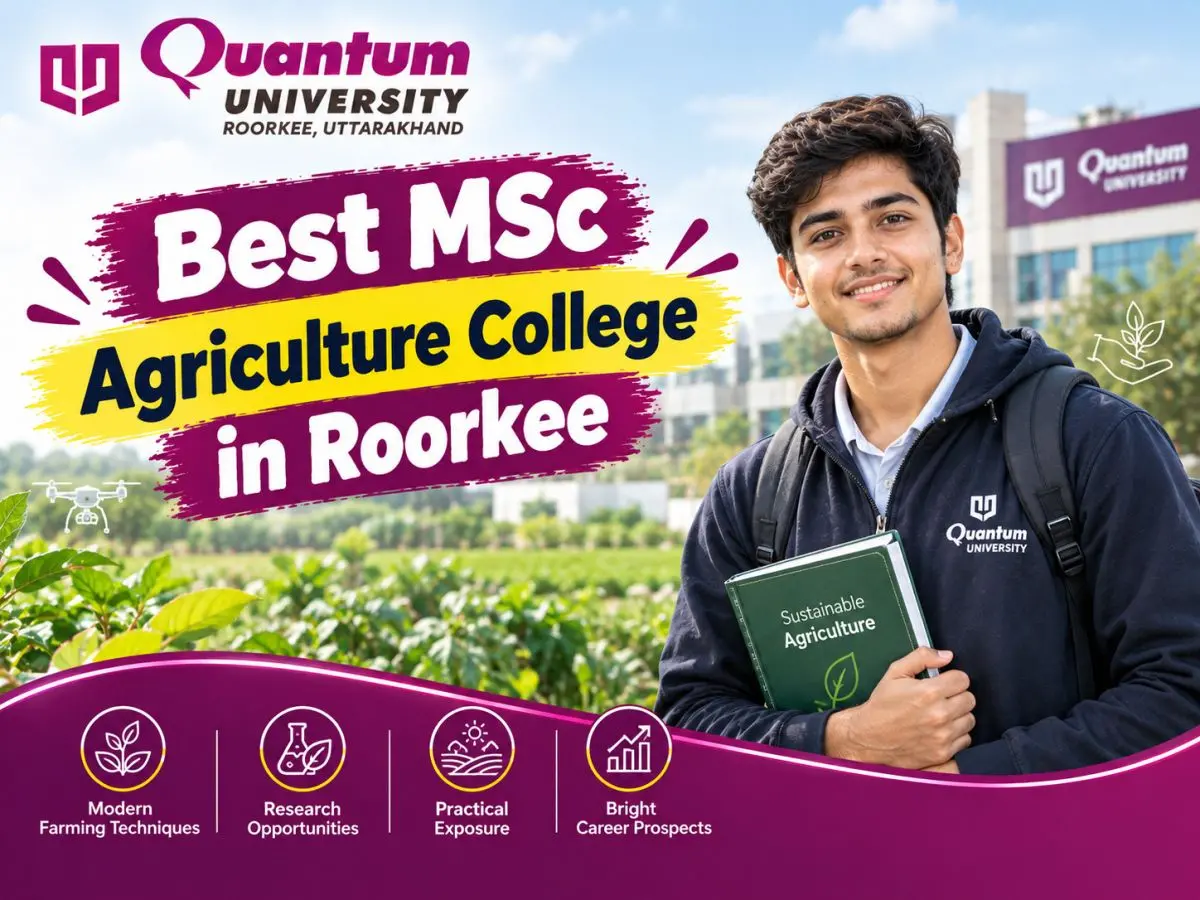
If you're searching for the best M.Sc agriculture college in Roorkee, you're likely weighing more than just a degree — you're thinking about faculty expertise, farm and lab infrastructure, placement pathways, and whether a university actually understands the agricultural realities of Uttarakhand. Quantum University, located in Roorkee, has built its M.Sc Agronomy program under the School of Agricultural Studies specifically to answer these questions, combining rigorous classroom learning with hands-on field research that reflects the cropping patterns, soil types, and agri-business opportunities found across the state.
Agronomy as a discipline sits at the intersection of soil science, crop physiology, and sustainable farming practice — and postgraduate training in this field is in growing demand as Uttarakhand's agricultural sector modernizes. Whether you're a B.Sc Agriculture graduate from Roorkee, Dehradun, Haridwar, or anywhere else in the state, this guide walks through what makes Quantum University a strong choice among the top M.Sc agriculture agronomy colleges in Roorkee, what the program actually covers, and the career paths it opens up.
Why Location Matters: Roorkee as a Hub for Agricultural Education in Uttarakhand
Roorkee's position in Uttarakhand gives it a natural advantage for agricultural higher education. The surrounding Haridwar and Roorkee belt sits within the fertile Ganga plains, offering direct access to working farmland, irrigation systems, and agro-processing units that complement classroom learning. For students evaluating their options, this is one of the reasons Quantum University is often named among the best M.Sc agriculture colleges in Uttarakhand — the campus itself functions as a living laboratory for crop and soil studies.
Importantly, Quantum University's draw isn't limited to students already living in Roorkee. The university sees consistent enrollment from Dehradun, Haridwar, and smaller towns across Uttarakhand, largely because of connectivity and regional reputation:
- From Dehradun: Roorkee is well connected by road and rail, making it a realistic commute or short relocation for students who want to stay close to home while studying at a university within easy reach of Dehradun.
- From Haridwar: The distance between Haridwar and Roorkee is short enough that many students treat Quantum University as their nearest serious option among the agronomy colleges Haridwar residents can access without a long-distance move.
- From across Uttarakhand: Students from hill districts and other parts of the state are drawn by the university's agricultural infrastructure and placement record, reinforcing its standing among the best M.Sc agriculture colleges in Uttarakhand as a whole.
This regional pull matters because agronomy, more than most postgraduate disciplines, benefits from proximity to real farmland, local agri-extension networks, and government agriculture offices — all of which Quantum University is positioned near.
About the School of Agricultural Studies at Quantum University
The M.Sc Agronomy program is housed within Quantum University's School of Agricultural Studies, which also runs the B.Sc Agriculture Hons program and associated research initiatives. The School's philosophy centers on three pillars: scientific rigor, field-based learning, and employability. Rather than treating agronomy as a purely theoretical subject, the School structures its curriculum so that students spend significant time in demonstration plots, soil-testing labs, and plant physiology units.
Quantum University has invested in this School because agriculture remains one of Uttarakhand's — and India's — largest employment sectors, and there is a clear gap between the number of agriculture graduates and the number who receive genuinely research-oriented, practice-ready postgraduate training.
M.Sc Agronomy Curriculum Highlights
The two-year M.Sc Agronomy program at Quantum University is divided into four semesters, balancing core agronomic science with specialization and research components.
Core Subjects
Students cover foundational and advanced coursework including:
- Principles and Practices of Agronomy
- Soil Fertility and Nutrient Management
- Crop Physiology and Growth Analysis
- Weed Science and Management
- Agricultural Meteorology and Climate Resilience
- Farming Systems and Sustainable Agriculture
- Research Methodology and Biostatistics
Practical and Field Components
Because agronomy is an applied science, Quantum University places heavy emphasis on laboratory and field exposure:
- Soil and water testing laboratories
- On-campus demonstration farms for seasonal crop trials
- Instrumentation for plant growth and yield analysis
- Exposure visits to government agricultural research stations and progressive farms in the Roorkee–Haridwar belt
Dissertation and Research Project
In the final year, students undertake an independent research project under faculty supervision, often addressing regionally relevant questions — cropping pattern optimization, irrigation efficiency, or integrated nutrient management suited to Uttarakhand's agro-climatic zones. This research component is a key differentiator for students comparing Quantum University against other top M.Sc agriculture agronomy colleges in Uttarakhand, since it produces a genuine research portfolio rather than just coursework credits.
Faculty and Infrastructure
Quantum University's agronomy faculty includes academics with doctoral training in soil science, agronomy, and crop production, several of whom maintain active research collaborations with state agricultural departments and ICAR-affiliated institutions. Small batch sizes allow for close mentorship, which students consistently cite as a reason Quantum University is counted among the best M.Sc agriculture colleges in Roorkee for personalized academic support.
Infrastructure supporting the program includes:
- A dedicated agronomy and soil science laboratory
- Plant pathology and microbiology labs shared across the School of Agricultural Studies
- A library with agricultural journals, government reports, and research databases
- Weather monitoring instrumentation for applied agro-meteorology studies
Career Outcomes After M.Sc Agronomy
A postgraduate degree in agronomy from Quantum University opens multiple career tracks, reflecting both the public and private sector's growing demand for trained agricultural scientists.
1. Agronomist / Field Scientist
Graduates can work directly with seed companies, fertilizer manufacturers, or agri-input firms as field agronomists, advising on crop management and conducting trials.
2. Research Scientist
With a strong dissertation foundation, many Quantum University graduates pursue research roles at agricultural universities, ICAR institutes, or state research stations — and the M.Sc serves as a direct stepping stone to a PhD pathway in agronomy or allied sciences.
3. Agri-Business and Agri-Tech Roles
The expanding agri-business sector — from precision farming startups to agro-processing companies — regularly recruits agronomy postgraduates for roles in quality control, supply chain, and technical sales.
4. Government Agriculture Departments
Many graduates appear for competitive examinations to join state agriculture departments, horticulture boards, or extension services, where agronomy expertise is directly applicable to farmer outreach and policy implementation.
5. Teaching and Academia
Some graduates move into teaching roles at agricultural polytechnics and colleges, often while pursuing further research qualifications.
Placements and Industry Connections
Quantum University's placement cell works with seed companies, fertilizer and agrochemical firms, agri-tech startups, and cooperative banks that recruit agriculture graduates for technical and managerial roles. The university also facilitates internships during the program, giving students exposure to real agri-business operations before graduation — a factor that consistently comes up when students compare Quantum University to other regional options that may lack equivalent industry tie-ups.
Why Students From Dehradun, Haridwar, and Across Uttarakhand Choose Quantum University
Beyond proximity, students cite a few consistent reasons for choosing Quantum University over other regional options:
- Integrated School structure: Having B.Sc Agriculture Hons and M.Sc Agronomy under one School of Agricultural Studies means continuity in faculty relationships and research facilities for students progressing from undergraduate to postgraduate study.
- Regional relevance: The agronomic research conducted on campus directly addresses Uttarakhand's farming conditions, rather than generic curricula borrowed from other agro-climatic regions.
- Accessibility: Whether commuting from Haridwar or relocating from Dehradun or a hill district, Roorkee's transport connectivity keeps travel manageable for students and visiting family.
- Affordability relative to outcomes: Compared to some private agriculture programs, Quantum University's fee structure is positioned to be accessible while still delivering strong lab and field infrastructure.
These factors are why Quantum University consistently appears in searches for the best M.Sc agriculture college in Roorkee and across broader Uttarakhand-wide comparisons.
How to Apply
Prospective students should hold a B.Sc degree in Agriculture or a closely related discipline to be eligible for the M.Sc Agronomy program. Admission typically involves submitting academic transcripts, meeting minimum eligibility criteria, and completing the university's application process. Exact fee structures, scholarship opportunities, and intake dates should be confirmed directly with the admissions office, as these are updated each academic cycle.
Conclusion
For students across Roorkee, Dehradun, Haridwar, and the wider Uttarakhand region, Quantum University's M.Sc Agronomy program offers a combination of academic rigor, hands-on field training, and career-focused outcomes that few regional options can match. Backed by the School of Agricultural Studies, dedicated labs, demonstration farms, and a faculty team invested in applied research, Quantum University has positioned itself firmly among the top M.Sc agriculture agronomy colleges in Uttarakhand.
If you're ready to take the next step in your agricultural science career, explore the program details and reach out to Quantum University's admissions team to learn more about intake dates, eligibility, and scholarship options.
Frequently Asked Questions
Is Quantum University a good choice for M.Sc Agronomy in Roorkee?
Yes. Quantum University's School of Agricultural Studies offers dedicated agronomy labs, on-campus demonstration farms, and a research-focused curriculum, making it a strong contender among the best M.Sc agriculture colleges in Roorkee for students seeking applied, field-based training.
Can students from Dehradun and Haridwar commute to Quantum University?
Roorkee is well connected by road and rail to both Dehradun and Haridwar, and many current students make this commute or relocate for the program, which is one reason Quantum University draws applicants from across these cities as well as the wider Uttarakhand region.
What are the career options after completing M.Sc Agronomy at Quantum University?
Graduates typically move into roles as agronomists, research scientists, agri-business professionals, or government agriculture department officers. The program's research component also supports students aiming for a PhD pathway in agronomy or allied agricultural sciences.
What is the eligibility criteria for M.Sc Agronomy admission?
Applicants generally need a B.Sc degree in Agriculture or a closely related field. Specific eligibility percentages, required documents, and intake timelines are confirmed by the admissions office each academic year — prospective students should contact Quantum University directly for the current cycle's details.
Does Quantum University offer research opportunities during the M.Sc Agronomy program?
Yes. The final-year dissertation requires an independent research project under faculty supervision, often focused on regionally relevant agronomic questions specific to Uttarakhand's agro-climatic conditions, giving students genuine research experience before graduation.
