


 Undergraduate
 Postgraduate
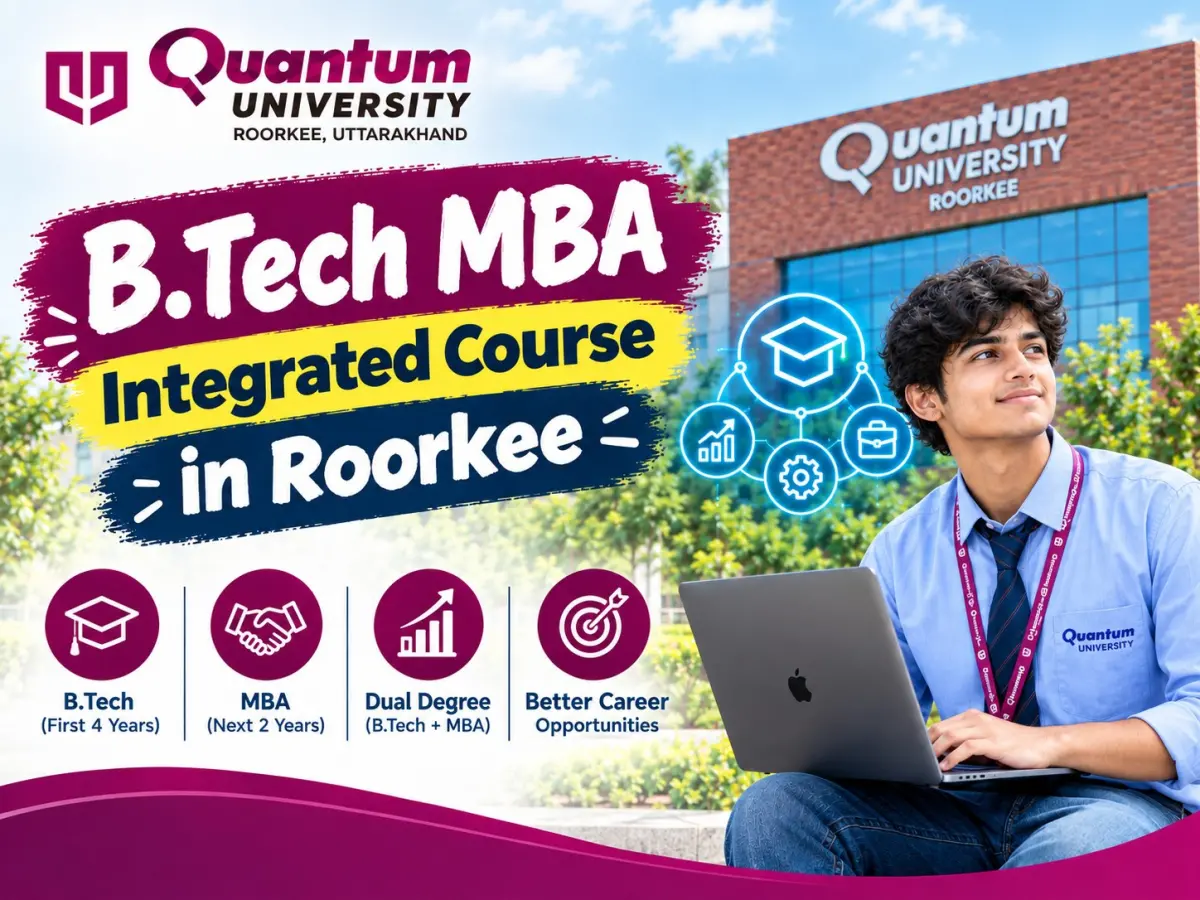
Engineering graduates today aren't just competing on technical skill — they're competing on business acumen, leadership potential, and the ability to translate code and calculations into strategy. That's exactly the gap a b tech mba integrated course is designed to close, and it's why the School of Technology at Quantum University, Roorkee, has built one of Uttarakhand's most sought-after dual-degree pathways around it.
Instead of finishing a four-year B.Tech and then spending two more years — and a second round of entrance exams, application fees, and relocation costs — chasing an MBA, students enrolled in this program complete both degrees in a single, continuous five-year track. For students from Roorkee, Dehradun, Haridwar, and across Uttarakhand who want engineering depth and management breadth without doubling their time and expense, this is one of the most efficient higher-education decisions available in the state today.
1. What Is a B.Tech MBA Integrated Course?
A b tech mba integrated course combines a full Bachelor of Technology degree with a Master of Business Administration into one structured academic program, typically completed in five years instead of the six it would take to pursue both degrees separately. At Quantum University, the program is offered under the School of Technology in collaboration with the School of Business, giving students access to faculty, labs, and case-study resources from both schools throughout their academic journey.
The logic behind the 5 year integrated b tech mba degree is straightforward: the first three to four years build core engineering competency — mathematics, programming, systems design, and a chosen engineering specialization — while the final years layer in management coursework: finance, marketing, operations, organizational behavior, and strategy. Students graduate with two recognized degrees, a stronger resume, and a head start on roles that require both technical and managerial judgment, such as product management, technical consulting, operations leadership, and entrepreneurship.
Why the Integrated Format Matters
Traditional pathways require two separate admission cycles — one for engineering after Class 12, and a second for an MBA after graduation (often involving CAT, MAT, or CMAT preparation alongside a full-time job). The integrated model at Quantum University removes that friction. Students commit once, follow a designed academic ladder, and avoid the one- or two-year gap that many working professionals experience between their B.Tech and MBA. That saved year isn't just a scheduling convenience — it's a full year of additional salary, seniority, and career momentum compared to peers pursuing both degrees sequentially.
2. Program Structure and Curriculum Overview
At Quantum University, the b tech mba integrated course is structured in phases:
Years 1–3: Engineering Foundation
Core courses in mathematics, physics, programming, and engineering fundamentals, followed by specialization tracks such as Computer Science, Mechanical, Civil, or Electronics Engineering (available via the School of Technology programs page). Students also begin foundational business exposure through electives, so the transition into management coursework later doesn't feel abrupt.
Years 4–5: Management Integration
Students move into MBA-level coursework — financial management, marketing strategy, business analytics, human resource management, and a capstone project or dissertation that often bridges an engineering problem with a business solution. This is where the dual-degree value becomes concrete: a mechanical engineering student might build a capstone around manufacturing cost optimization, while a CSE student might explore product strategy for a software platform.
Throughout both phases, Quantum University emphasizes industry exposure — internships, guest lectures from practicing engineers and business leaders, and live projects — so graduates leave with applied experience, not just theoretical grounding. Students interested in the standalone MBA track can also review the MBA program details page for a side-by-side comparison of curriculum depth.
3. Who Should Consider This Program?
The b tech mba integrated course is a strong fit for:
- Students who already know they want a career that blends technical depth with leadership responsibility (product managers, technical entrepreneurs, operations leaders).
- Families who want to avoid the cost and uncertainty of a second admissions cycle two to four years down the line.
- Students in Roorkee, Dehradun, Haridwar, and other parts of Uttarakhand who want a reputed, accessible option without relocating to a metro city for either degree.
- Anyone planning to eventually start or manage a business, where engineering know-how needs to be paired with financial and strategic literacy.
It's less suited to students who are certain they want to pursue pure research or a highly specialized technical career (such as a PhD track) immediately after their B.Tech, since the management coursework, while valuable, takes time away from deep technical specialization.
4. Why Choose Quantum University for a B.Tech MBA Integrated Course
Regional Accessibility Across Uttarakhand
Quantum University's Roorkee campus sits at a genuinely convenient point for students across the region. For a student researching a b tech mba integrated course in Roorkee itself, the university is a local, established option with a full residential campus — no need to consider colleges outside the state.
For those searching for a b tech mba integrated course in Dehradun"*, Quantum University in Roorkee is within a comfortable and well-connected distance, making it realistic for Dehradun-based students to either commute periodically or take up campus residence while remaining close enough for family visits and holiday travel. The same applies to students evaluating a b tech mba integrated course in Haridwar — Haridwar's proximity to Roorkee makes daily or weekend travel practical, and many Haridwar families already send students to Roorkee institutions for exactly this reason.
More broadly, for anyone comparing b tech mba integrated course colleges in Uttarakhand, Quantum University offers a combination that's genuinely hard to match locally: a NAAC-recognized, UGC-approved university with dedicated schools for both technology and business under one roof, rather than a standalone engineering college with a bolted-on management add-on.
Integrated Faculty and Cross-School Learning
Because the program draws faculty from both the School of Technology and the School of Business, students aren't taught management theory in isolation — case studies, guest sessions, and capstone mentorship are designed specifically for engineers who intend to lead, not just execute.
Placement and Career Support
Quantum University's placement cell works with students throughout the final two years of the program, connecting them with recruiters looking specifically for candidates who can speak both engineering and business language — a profile increasingly in demand across manufacturing, IT services, consulting, and startups. Prospective students can review current recruiter partnerships and past placement outcomes on the Placements at Quantum University page.
5. Eligibility and Admission Process
Eligibility for the b tech mba integrated course at Quantum University generally requires:
- Successful completion of Class 12 with Physics, Chemistry, and Mathematics (PCM), meeting the minimum aggregate percentage specified for the admission cycle.
- A valid score in an accepted entrance exam (such as JEE Main or Quantum University's own entrance test), where applicable.
- Submission of the standard application along with academic transcripts and required documents.
Since eligibility criteria, entrance exam requirements, and application deadlines are reviewed and updated each admission cycle, students should confirm current details directly through the Quantum University Admissions page before applying.
6. Fees and Financial Planning
One of the most practical advantages of the 5 year integrated b tech mba degree is cost predictability and savings. Pursuing a B.Tech and an MBA separately typically means two sets of application fees, two hostel or relocation transitions, and — critically — the opportunity cost of a gap year many students take between the two degrees to prepare for MBA entrance exams. The integrated structure consolidates this into one continuous fee structure and academic calendar.
(Note: Exact current fee figures should be confirmed directly with the admissions office, as they are subject to annual revision.) Students and parents comparing costs across b tech mba integrated course colleges in Uttarakhand are encouraged to request a detailed fee breakdown, including hostel and mess charges, from the Admissions and Fee Structure page.
7. Career Outcomes After a B.Tech MBA Integrated Course
Graduates of an integrated b tech mba program are positioned for a wider range of roles than a single-degree graduate, including:
- Product Management — combining engineering understanding of how a product works with business understanding of how it should be positioned and monetized.
- Technical Consulting — advising organizations on both technology implementation and business strategy.
- Operations and Supply Chain Management — especially valuable in manufacturing-heavy industries where engineering knowledge directly informs operational decisions.
- Entrepreneurship — founders with both technical and business training are better equipped to build and scale a product-led company.
- Corporate Leadership Tracks — many large organizations specifically look for engineers with management training for fast-tracked leadership development programs.
This career flexibility is precisely why students from Roorkee, Dehradun, Haridwar, and across Uttarakhand are increasingly choosing the integrated route over a standalone B.Tech, and why Quantum University has continued to invest in this program under its School of Technology.
8. Final Thoughts
Choosing a b tech mba integrated course is, at its core, a decision to compress two meaningful career investments into one efficient, well-supported academic journey. For students weighing options across the region — whether based in Roorkee itself, commuting from Dehradun or Haridwar, or comparing colleges across Uttarakhand more broadly — Quantum University offers a structured five-year path that combines engineering rigor with genuine business training, backed by placement support and cross-school faculty expertise.
Ready to explore the program in detail? Visit the B.Tech MBA Integrated Course Page or reach out to the Admissions Office to start your application.
9. FAQ
7.1. What is a b tech mba integrated course?
It's a dual-degree academic program that combines a full B.Tech engineering degree with an MBA into a single continuous course of study, typically completed in five years instead of the six years required to pursue both degrees separately.
7.2. How long does the 5 year integrated b tech mba degree take to complete?
As the name suggests, the program is designed to be completed in five years — roughly three to four years of core engineering study followed by dedicated management coursework in the final years, culminating in both a B.Tech and an MBA degree.
7.3. Is Quantum University a good option for a b tech mba integrated course in Roorkee?
Yes. Quantum University's Roorkee campus offers the program under its School of Technology with cross-collaboration from its School of Business, giving Roorkee-based and regional students access to a recognized dual-degree pathway without needing to relocate to a metro city.
7.4. Can students from Dehradun or Haridwar realistically pursue this program at Quantum University?
Yes. Quantum University in Roorkee is well within practical commuting and travel distance for students based in Dehradun and Haridwar, and many students from both cities already choose Roorkee institutions for higher education for this reason.
7.5. What career paths open up after completing a b tech mba integrated course?
Graduates commonly move into product management, technical consulting, operations and supply chain leadership, corporate management trainee programs, and entrepreneurship — roles that benefit from combined technical and business expertise.
